AI Video Production
Kontakt aufnehmenThe ad industry's in the middle of a shift as big as analogue to digital. AI is rewriting how video gets made, from first concept to final cut. Two years ago this was science fiction. Today it's production reality, and we're building in it every day.
We've been producing advertising for over two decades. We've watched the technology jumps come and go: SD to HD, broadcast to platform-native, full crews to remote shoots. What AI is doing to video right now moves faster and reaches further than any of those. The tech itself isn't the story. The story is what happens when experienced producers put it to work, and the kind of speed and creative range that opens up.
The market, meanwhile, is full of half-truths. Every week another tool launches promising anyone can produce a broadcast-ready ad in minutes. Reality's messier. AI doesn't replace strategy, craft or brand thinking. It's a tool. A genuinely powerful one, but a tool, and the outcome depends entirely on who's holding it. So the honest question is worth asking: what can AI video production actually do today, where does it still fall short, and why does the mix of technology and agency experience matter more than either on its own?
What AI Actually Delivers in Video Production
Let's be straight: plenty of what gets badged as 'AI video' doesn't deliver on the pitch. A lot of it looks brilliant for three seconds. Then you spot the strange movement, the hand with six fingers, the texture that collapses when you look twice. That's where fully AI-generated video sits today without human post. The genuine value is elsewhere.
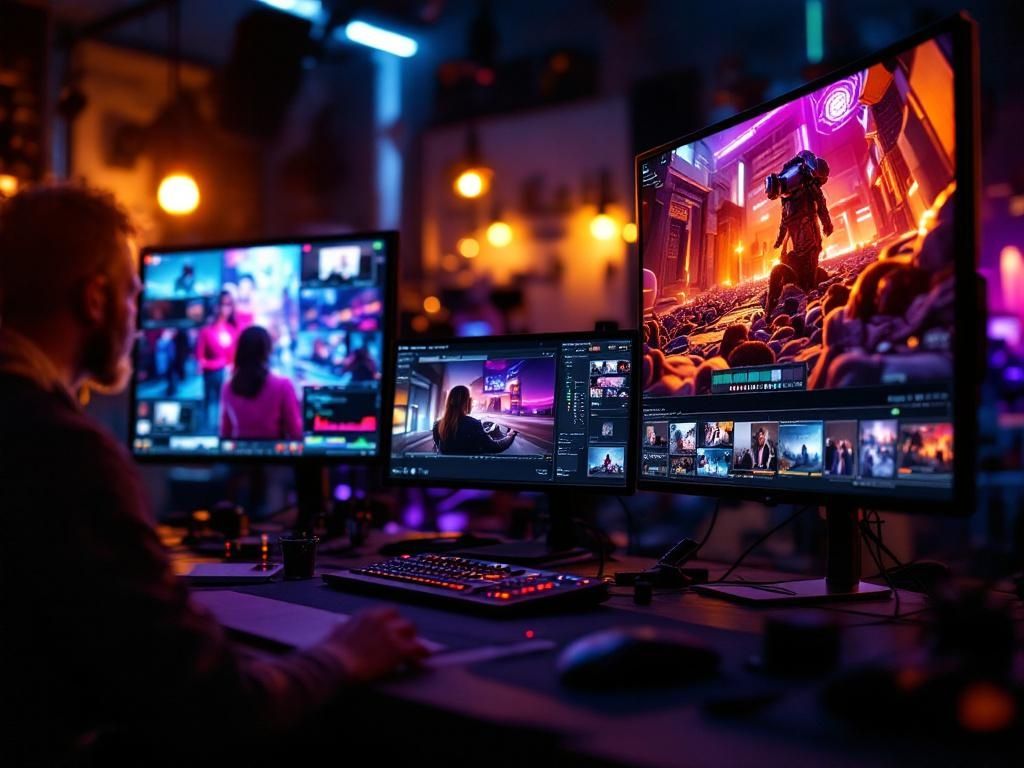
The real shift isn't AI spitting out finished ads. It's AI collapsing individual production steps. Storyboard visuals that used to take days take hours. Backgrounds and environments get generated instead of filmed or built in 3D. Colour work that would've kept a colourist busy all day lands in minutes. Audio cleanup, auto-subtitling, reframing for every platform ratio: all of it runs reliably and is ready for real work today.
The most interesting use sits earlier, in the concept phase. We put generative AI to work on visual drafts during pitches, the kind of material that used to need full pre-production to exist at all. That changes the decision-making completely. Clients see where a piece is heading before anyone's spent serious money, and they make sharper calls because of it. Time saved on both sides. The creative process doesn't disappear. It just becomes visible earlier.
Applications: From Social Clips to TV Ads
AI video isn't a single product. How much AI makes sense depends on format, platform and what the work has to do. For social clips with a 48-hour lifespan that need shipping at volume, the efficiency gain's obvious. We can turn out variants in a fraction of the usual time, A/B test them, and move fast when trends shift. TikTok, Reels and Shorts move at a pace that demands exactly this kind of agility.
Traditional ads raise the bar. Brand impact, emotional accuracy, technical finish: a spot running on cinema screens or prime-time TV won't forgive AI artefacts. Here we use AI deliberately in pre and post, for mood boards, previz, VFX elements and compositing. The core scenes, the ones with real faces, real emotion, real moments, are still shot on camera with a director. AI still earns its place around them, through auto-tagging footage, edit suggestions, and generating transitions and motion graphics.
Explainer and product films are where things get interesting too. B2B products tend to be complex and visually flat. AI opens up ways to show them that didn't exist before. Abstract processes become visual. Data flows get legible. Inside views of machinery happen in animated cutaway, all built from AI-generated imagery we shape to the brand's design system. The finish matches work that would've cost six figures in animation a few years back.
AI Video Production in Practice: How We Work
Theory's one thing. What matters is what actually happens in production. A typical AI-powered project with us starts where every good project starts: the strategic conversation. What should this video do? Who's it for? Where will it run? That phase is fully human and always will be. No algorithm gets near the conversation that figures out what a brand stands for and what story it needs to tell.
Once the brief's clear, the concept phase opens and AI steps in. We generate visual concepts, mood frames and scene directions. Clients see something concrete within days instead of waiting weeks for a storyboard. That isn't a party trick. It's reshaped our approval process for the better. Production itself runs hybrid. On a recent job for a technology client we shot the interviews properly, on camera with a crew, and built every technical visualisation with AI. The finish beat pure 3D animation on screen and came in at half the schedule.
Post is where AI really earns its keep. Colour matching across scenes, audio optimisation, reframing for every format the client needs: all semi-automated, freeing our editors to focus on what actually moves an audience. Pacing, timing, the emotional arc. Quality control stays fully human. Every frame that leaves our studio is signed off by an experienced producer. AI delivers the raw material. We deliver the result.
Why Proven Expertise Makes the Difference
The AI video market's splitting in two directions. On one side, tech startups with slick demos and no grasp of brand strategy, media law or what it takes to deliver a real campaign. On the other, traditional production houses treating AI as a threat and pretending it isn't there. We've planted ourselves firmly in the middle: two decades of advertising production experience, plus the willingness to take new technology seriously and fold it into the quality standards we already hold ourselves to.
That combination is exactly why we picked up Leading Innovator in 2026. Not because we jumped on every new tool first. Because we know when a tool belongs in the process and when it doesn't. AI in video production isn't the point. It's useful when the people using it understand the craft: how an edit creates emotion, how lighting carries a story, how sound design puts the hairs up on your arms. You can't automate that. You can sharpen it with AI.
If you're weighing up AI-powered video production, start with an honest read of the project. Not every brief needs AI. Not every AI-generated video comes out better or cheaper. What AI brings is speed, variation and visual options that didn't exist before. What we bring is the judgement to use them in ways that build your brand and hit your targets. We've been making video that works since 2002. We're doing it now with the best tools we've ever had, and with the belief that technology hits hardest when it's in the hands of people who know what they're doing.