AI Product Photography
How AI-Generated Images Are Transforming E-Commerce - Faster, Smarter, More Compelling
Request a consultationIn e-commerce, the product image makes the sale. Not the price, not the description - the image. Studies have shown this for years: quality product photos boost conversion rates by up to 30%. Customers buy what they can see. What they can picture themselves using. And that's precisely where the challenge lies for online shops with hundreds or thousands of products in their range.
Because professional product photography is labour-intensive. Every single product needs photographing - often from multiple angles, with different backgrounds, for various channels. A photoshoot for one collection takes days. Post-production takes just as long again. And when your product range changes, you start the whole process over. It eats up time, burns through budget, and slows your time-to-market.
AI product photography fundamentally changes this equation. Not as a gimmick, not as a cheap substitute - but as a professional tool that creates product images with a quality that was unthinkable two years ago. We've been using this technology for our clients for months and we know what works and what doesn't. This article shows where AI-generated images can already replace traditional photography in e-commerce today - and where the limitations still lie.
--- **SECTION_2** (Why traditional product photography hits the wall):Why traditional product photography falls short
Traditional product photography works. That's not in question. The real question is whether it still makes economic sense - especially for e-commerce businesses that are scaling fast or managing huge product ranges. A professional photo studio costs between £700 and £1,800 per day. Add photographers, stylists, props, and post-production. For a fashion retailer with 500 products per season, you're quickly looking at five-figure costs - per collection.
Then there's the time factor. From product arrival to finished image often takes two to four weeks. The product needs shipping to the studio, the shoot needs coordinating, post-production takes time. In a market where Amazon sellers list new products daily, that's a real competitive disadvantage. Fall behind on speed, and you lose visibility - and revenue.
There's also the consistency problem. When you're shooting over months, you're dealing with different photographers, changing light, varying setups. The result? Product images that differ in colour temperature, shadows, and overall feel. For an online shop wanting consistent brand presentation, that's a headache. And for marketplaces like Amazon or Zalando with strict image guidelines, it becomes a genuine risk.
Then there's an often overlooked factor: variants. One t-shirt in twelve colours means twelve separate shoots. A handbag in three sizes and five colours means fifteen shoots for a single product. Costs don't just increase linearly - they explode exponentially. This is exactly where AI product photography becomes a serious alternative.
--- **SECTION_3** (What AI product photography can deliver today):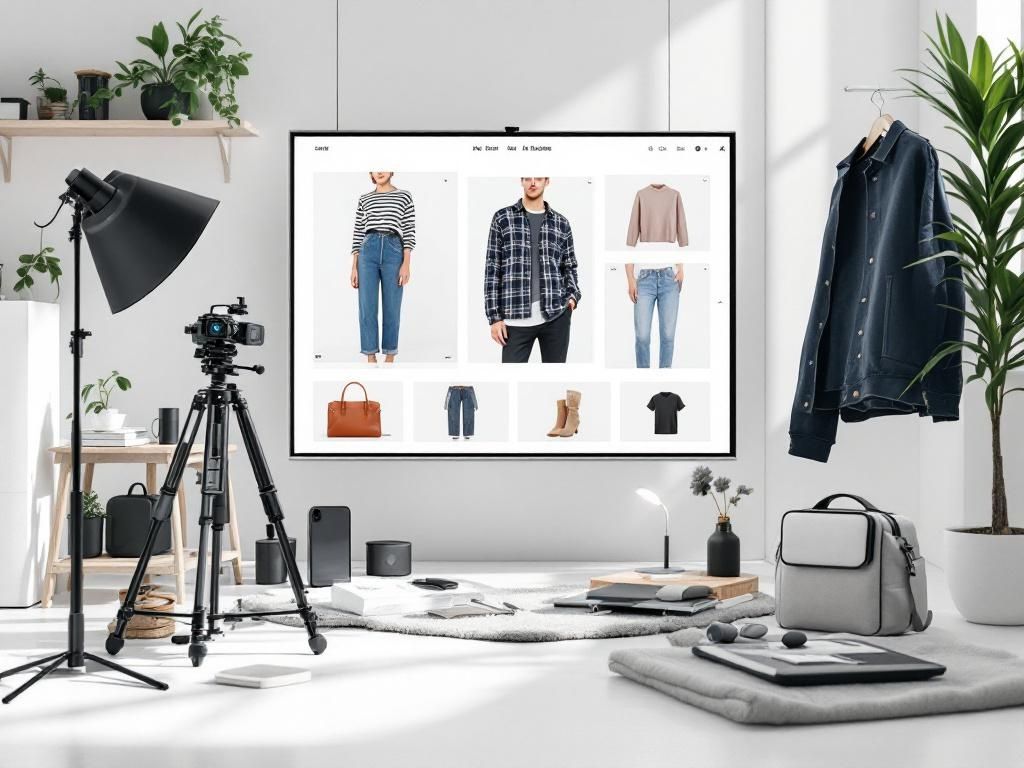
What AI product photography can deliver today
AI-generated product imagery has made a quality leap in the past eighteen months that's surprised even industry veterans. Modern diffusion models now create images that match professional studio shots in resolution, detail and lighting. This isn't marketing hype - it's measurable. In blind tests, even experienced art directors often can't tell AI-generated product photos from traditional shots.
Here's how AI product photography actually works: You start with an existing product photo - even a simple snapshot or CAD rendering will do. The AI extracts the product, understands its shape, materials and surface, then places it in a completely new context. That could be a clean white background for Amazon, a lifestyle scene for your own shop, or seasonal settings for campaigns. All from a single source image.
What's particularly impressive is how accurately it handles materials. Leather looks like leather, cotton has the right texture, metal reflects believably. This was AI imagery's biggest weakness in e-commerce just a year ago. Now it's a real strength - provided you know how to control the systems properly. The quality of your results depends entirely on how well you craft prompts and fine-tune the output.
What makes AI product photography genuinely powerful is the scale. Once you've defined your image styles, you can apply them across your entire range. Colour variants get created in minutes rather than hours. Seasonal backgrounds swap out with a single click. And when a marketplace introduces new image requirements, your whole portfolio gets updated in hours - not weeks. For e-commerce businesses with large product ranges, this changes everything.
--- **SECTION_4** (Use cases: From fashion to industrial):Applications: From Fashion to Industrial
AI product photography works across more sectors than most people realise. Fashion is the obvious starting point. Fashion retailers typically need four to six images per product: front view, back view, detail shots, model shots, flat lays, and lifestyle scenes. AI fashion photography can now generate all these variants from a single photograph. Models are virtually dressed, lighting is adjusted, backgrounds are switched. The results are so convincing that several major European fashion platforms have already switched entirely to AI-generated images for product variants.
In furniture and interior design, AI product photography shows its strength through contextualisation. A sofa against a white background sells moderately well. The same sofa in a stylishly furnished living room, with warm lighting and matching accessories, sells significantly better. Traditionally, this means a completely furnished set for every piece of furniture. With AI images for e-commerce, one cut-out photograph is enough - technology handles the rest. This doesn't just cut costs - it also allows you to show the same product in different room styles to appeal to different target audiences.
In cosmetics and beauty, AI product photography now delivers remarkable results. Glass bottles with accurate light refraction, cream jars with realistic textures, lipsticks with precise colour reproduction. For cosmetic brands constantly launching new colours and limited editions, the effort per product drops dramatically. Instead of setting up a complete shoot for every new colour variant, the product variation is created digitally.
In industrial and B2B commerce, the benefits are different but equally relevant. Here it's less about lifestyle scenes and more about technical accuracy and consistency. Industrial products in uniform presentation, with standardised perspectives and correct proportions - this is efficiently achievable with AI. For companies maintaining catalogues with thousands of items, the time savings are substantial. Product photos that previously required individual studio work are now generated in series - with consistent quality.
Why expertise makes the difference
Now we need to be honest. The tools for AI product photography are freely available. Midjourney, DALL-E, Flux - theoretically, any online shop owner can generate product images themselves. Theoretically. In practice, it's different. Because between a generic AI image and a product photo that sells, there's a significant difference. And that difference is called expertise.
We see this daily with clients who initially created AI product photos themselves before coming to us. The most common problems: materials look plastic rather than authentic. Proportions aren't quite right - barely visible, but noticeable. Shadows fall unnaturally. And crucially: the images lack a consistent look because each was created individually with different prompts. The result is a product catalogue that somehow feels artificial, without viewers being able to say exactly why.
As an AI video production agency that's been creating visual content since 2002, we bring something no tool can replace: a trained eye for what works. We know which image style converts on which marketplace. We understand the requirements of Amazon, Zalando, Shopify and WooCommerce. We grasp lighting, composition and colour psychology - not because we've watched a tutorial, but because we've been practising it for over two decades. Our Leading Innovator 2026 award reflects exactly this: combining technological innovation with craft expertise.
And we're honest about limitations. There are products where real photography is the better choice. High-end watches where every light detail on the bezel must be perfect. Jewellery where exact colour reproduction of gemstones is crucial. Food where texture must stimulate appetite. In these cases, we recommend traditional photography - or a hybrid approach where the main product is photographed and context added via AI. Because the goal isn't to do everything with AI. The goal is finding the most economical and visually effective solution for each product. That's exactly how we support our clients - with technology, expertise and a clear view of what actually sells.
Ready for scalable product images?
Whether it's 50 or 5,000 products - we'll show you how AI product photography works for your business.
Discuss project