AI Video Production
Kontakt aufnehmenThe advertising industry is facing a transformation as significant as the shift from analogue to digital. AI video production is fundamentally changing how moving images are created - from initial concept to final edit. What sounded like science fiction two years ago is now production reality. And we're right at the heart of it.
As an agency with over 20 years' experience in advertising production, we've navigated quite a few technology leaps. The move from SD to HD, from linear broadcast to platform-specific content, from traditional shoot days to remote productions. But what artificial intelligence is making possible in video production right now surpasses everything we've seen before in both speed and scope. Not because the technology alone is so impressive, but because in the hands of experienced producers, it unlocks completely new levels of efficiency and creativity.
At the same time, we're seeing a market full of half-truths. Every week, new tools appear promising that anyone can create an AI advert in minutes. Reality is more nuanced. AI isn't a magic button that replaces strategy, craft and brand understanding. It's an exceptionally powerful tool - but still just a tool. And like any tool, the experience of whoever's using it determines the outcome. That's exactly why it's worth looking closer: What can AI video production actually deliver today, where are the limits, and why is the combination of technology and agency expertise the deciding factor?
What AI actually delivers in video production
Let's be honest: not everything labelled as AI-generated video lives up to its promises. Some results look impressive - for about three seconds. Then you notice unnatural movements, hands with six fingers, or textures that dissolve under closer inspection. That's the current state of purely AI-generated video creation without human post-production. And yet the technology is already delivering enormous value for professional production.
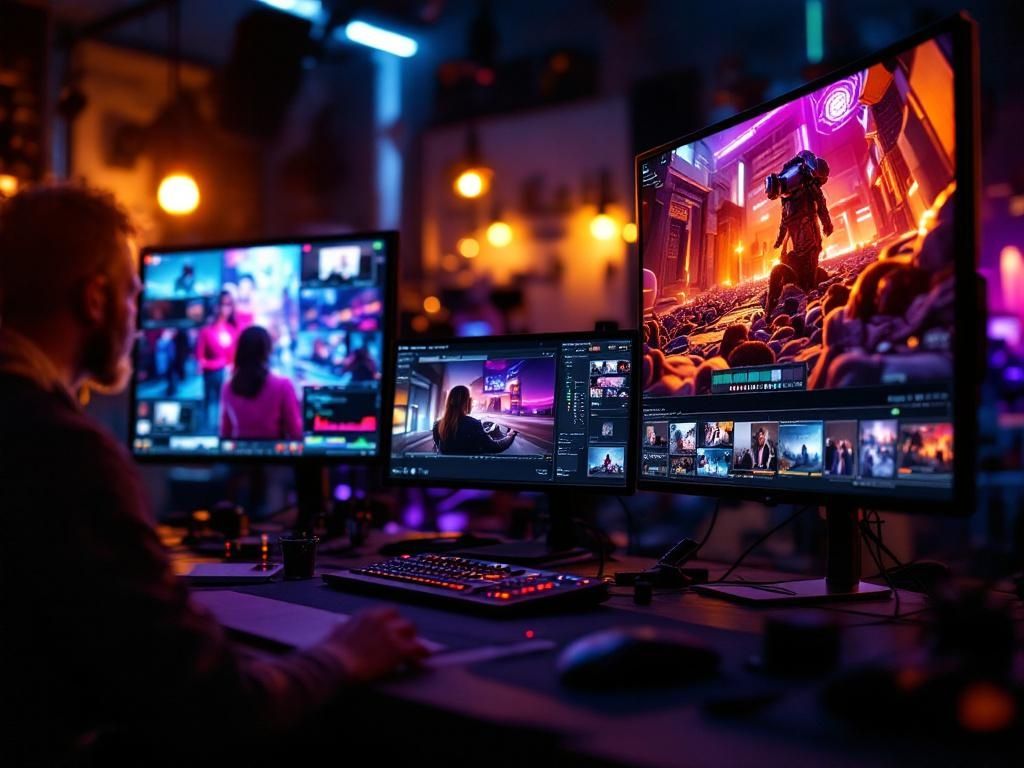
The real breakthrough isn't in automatically creating finished adverts. It's in massively accelerating individual production steps. Storyboard visualisation that used to take days now happens in hours. Background scenes and environments can be generated rather than filmed expensively or built in 3D. Colour corrections that a colourist would manually spend hours on are brought to consistent levels in minutes through AI-powered tools. Audio cleanup, automatic subtitling, intelligent reframing for different platform formats - these are all areas where AI works reliably and is production-ready today.
It gets particularly exciting when it comes to creating AI video for concept phases. We use generative AI to show clients visual drafts during pitches that previously would only have been possible after commissioned pre-production. This changes the entire decision dynamic. Clients see early on where things are heading and can make more informed decisions. It saves time and budget on both sides. The technology doesn't replace the creative process - it makes it more visible and tangible before actual production begins.
Applications: From social clips to TV adverts
AI video production isn't a one-size-fits-all product. Depending on format, platform and communication objective, the sensible level of AI involvement varies considerably. For social media clips with a 48-hour shelf life that need producing at high frequency, using AI is a clear efficiency gain. Here we can use AI-powered workflows to produce variants in a fraction of the usual time, run A/B tests and react quickly to trends. The speed at which platforms like TikTok, Instagram Reels or YouTube Shorts evolve demands exactly this agility.
With traditional AI adverts, it becomes more demanding. Here it's about brand impact, emotional precision and technical perfection. An advert running on big screens or in cinemas won't forgive AI artifacts. In this area, we deploy AI strategically in pre-production and post-production - for mood boards, previsualization, VFX elements and compositing. The core scenes with people, genuine emotions and authentic moments are still created with cameras and direction. But even here, AI film production significantly accelerates the overall process, through automated footage tagging, intelligent edit suggestions or generating transitions and graphic elements.
Another application gaining importance is explainer and product videos. Particularly in B2B, where products are often complex and visually unremarkable, AI opens up completely new presentation possibilities. Abstract processes can be visualised, data flows become visible, complex machinery can be shown in animated cutaway views - all based on AI-generated visuals that we fit into the brand's editorial and design framework. The result delivers production quality that would have required six-figure animation budgets just a few years ago.
AI video production in practice - How we work
Theory's one thing, production reality's another. So we'd like to show you how a typical AI-powered video project actually works with us. It always starts with strategic clarification: what should the video achieve, who's the target audience, which channels will it run on? This phase is completely human and always will be. No algorithm replaces the conversation where we understand what makes a brand tick and which story needs telling.
Once the brief's set, the concept phase begins - and here's where AI first comes into play. We generate visual concepts, mood imagery and initial scene suggestions. Instead of waiting weeks for a storyboard, our clients see concrete visual directions within days. This isn't a gimmick - it's fundamentally improved our approval processes. Production itself is hybrid. Depending on the project, we combine real shoot days with AI-generated elements. On a recent project for a technology client, we filmed the interview sequences traditionally but produced the technical visualisations entirely with AI support. The result was visually superior to pure 3D animation and finished in half the time.
In post-production, AI video production shows its full strength. Automatic colour matching across different scenes, AI-based audio optimisation, intelligent reframing for various output formats - all this now happens semi-automatically while our editors focus on what really matters: the dramatic fine-tuning, timing, emotional arc. Quality control remains uncompromisingly in human hands. Every frame leaving our studio gets checked and approved by experienced producers. AI delivers the raw material, we deliver the result.
Why proven expertise makes all the difference
The AI video production market is being pulled in two directions right now. On one side, you've got tech startups showcasing impressive demos but with zero understanding of brand strategy, media law, or what it actually takes to deliver a real campaign. On the other side, traditional production houses see AI as a threat and simply ignore it. We've deliberately positioned ourselves in the middle - bringing over two decades of advertising production know-how plus the willingness to not just use new technology, but integrate it properly into established quality standards.
This combination is exactly why we won Leading Innovator in 2026. Not because we're fastest to adopt the latest tools, but because we know when each tool makes sense and when it doesn't. Artificial intelligence in video production isn't an end in itself. It's valuable when it's used by people who understand their craft - who know how an edit creates emotion, how lighting tells a story, and how sound design gives you goosebumps. You can't automate that knowledge. But you can use AI to take it to the next level.
If you're considering AI-powered video production, we'd recommend an honest assessment first. Not every project needs AI, and not every AI-generated video is automatically better or cheaper. What AI gives you is speed, variation and new visual possibilities. What we give you is the know-how to use those possibilities in ways that strengthen your brand and hit your targets. We've been producing video content that works since 2002. Today we're doing it with the best tools that have ever existed. And with the firm belief that technology is strongest when it's guided by people who know what they're doing.